The world has moved past the Cold War.
Canada’s interests today are not the same as they were decades ago.
The majority of Vietnamese Canadians today are not refugees; many can act as bridges to Vietnam, ASEAN and the Indo-Pacific.
Rethinking Our Diaspora Policy:
The importance of the “value of our strength”
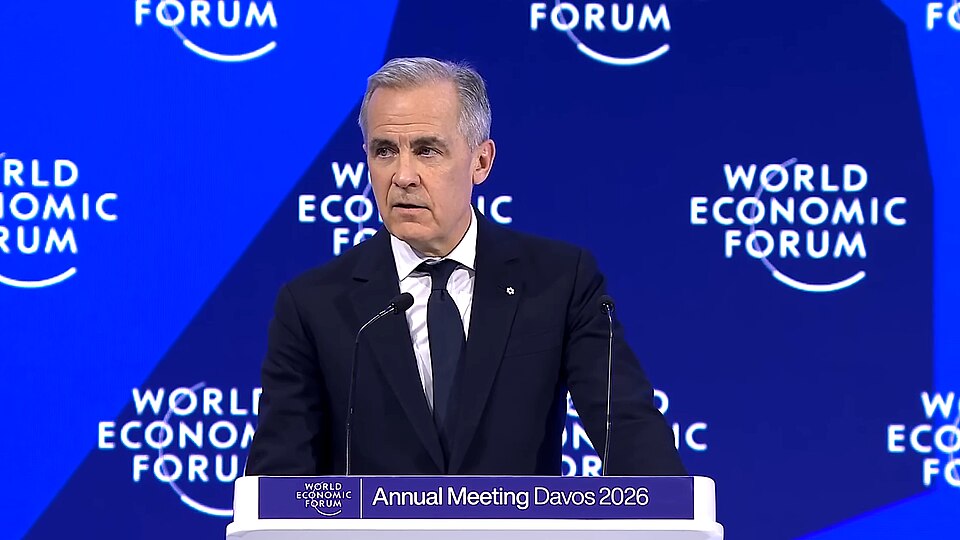
In his speech at Davos on Jan. 20, Prime Minister Mark Carney put it simply: “We are no longer just relying on the strength of our values, but also the value of our strength.”
Canada’s strength is apparent in our economic resilience during the current trade war with the United States. We made tremendous efforts to reduce our reliance on the U.S. Early signs of trade diversification are encouraging.
But building our economic strength means more than finding new markets. It also means making better use of the relationships and connections we already have. Vietnam is a good example.
Canada’s trade with Vietnam
In 2025, two-way merchandise trade between Canada and Vietnam totalled $20.6 billion. But imports from Vietnam were $19.3 billion, compared with just $1.3 billion in Canadian exports.
There is clearly more potential to export to Vietnam, creating jobs for Canadians and strengthening our economy.
And business often starts with relationships. That is where Canada’s Vietnamese diaspora can play a much greater role.
The Vietnamese diaspora: still constrained by Cold War thinking
We often discuss the important role of diasporas as bridges for trade and investment. Yet a quick search for “Vietnam” in major Canadian newspapers still produces very little coverage beyond Vietnamese food — notably banh mi and pho — and stories about the plight of Vietnamese refugees who arrived in Canada as the so-called “boat people.”
That history matters. Many Vietnamese refugees endured extraordinary hardship, and their experiences inevitably shaped their views of Vietnam and its government.
But much time has passed.
The Cold War narrative of the so-called Vietnamese “boat people” continues to influence some Vietnamese Canadian organizations and political voices, opposing closer relations and trade with Vietnam.
Those views are part of the Vietnamese community’s history. They should not, however, define the community’s future.
Public discourse about Vietnamese Canadians remains shaped by Cold War-era divisions, overlooking the community’s evolution and Vietnam’s growing role in the world.
A new Vietnamese Canadian community
There are more than 300,000 Vietnamese Canadians today. They are more diverse than the stereotypical refugee story alone suggests.
Since the 1990s, many Vietnamese Canadians have arrived as business owners, skilled workers, professionals and international students. Many have connections to Vietnam that can be valuable to Canada.
These newer waves of Vietnamese Canadians can play a crucial role in building what Mr. Carney calls the “value of our strength.”
Yet their potential is not always fully recognized. Part of the reason is that public discussion of the Vietnamese Canadian community has remained anchored in the politics and divisions of the Cold War.
Domestic politics should not trump foreign policy
In 2015, at the height of the federal election, Carleton University’s David Carment argued that manipulating diaspora politics for political gain could divide Canadians and called for an official policy on the issue.
He pointed to Minister Jason Kenney’s crass involvement of attracting Vietnamese Canadian votes through Bill S-219, federal legislation commemorating the Fall of Saigon. The goal was to pander to a segment of Vietnamese Canadians who identified themselves with the U.S.-backed Saigon government, enabling them to intimidate other Vietnamese Canadians who did not agree with them through threats of violence.
The Twitter post showed Mr. Kenney at a Journey to Freedom Day event in Mississauga in 2015 with the banner promoting “national hatred“.
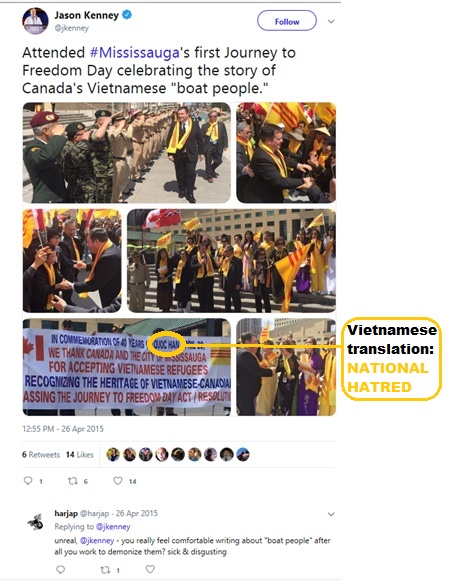
Canadians respect the rights to peaceful assembly and freedom of expression. Those rights should always be protected.
But Canadian politicians should not encourage division and discord within diaspora communities for electoral advantage when doing so makes it much harder to pursue Canada’s broader economic and strategic interests.
The way forward, not backward
The world has moved past the Cold War.
Canada’s way forward, as Mr. Carney said at Davos, must be “principled and pragmatic.”
That does not mean ignoring history or asking diaspora communities to abandon deeply held beliefs. It means recognizing that Canada’s interests today are not the same as they were decades ago.
We should support diaspora communities who want to contribute to Canada and who can act as bridges connecting Canadians to the world, creating mutually beneficial opportunities in trade, investment, education and culture.
We should rethink not only our relationship with Vietnam, but also how we think about the Vietnamese Canadian community. Our diaspora communities are part of Canada’s strength. The challenge is to recognize that strength and put it to work for Canada.
We should support diaspora communities who can act as bridges connecting Canadians to the world, creating mutually beneficial opportunities in trade, investment, education and culture.
Further reading: How Canada Can Turn The Canadian Diaspora Into An Economic Advantage by Kumaran Nadesan, Forbes (2026)